
Waterproofing coatings inspection
Polyurea and bituminous systems on tanks, architectural pools and concrete structures: adhesion, continuity, moisture and singular points.
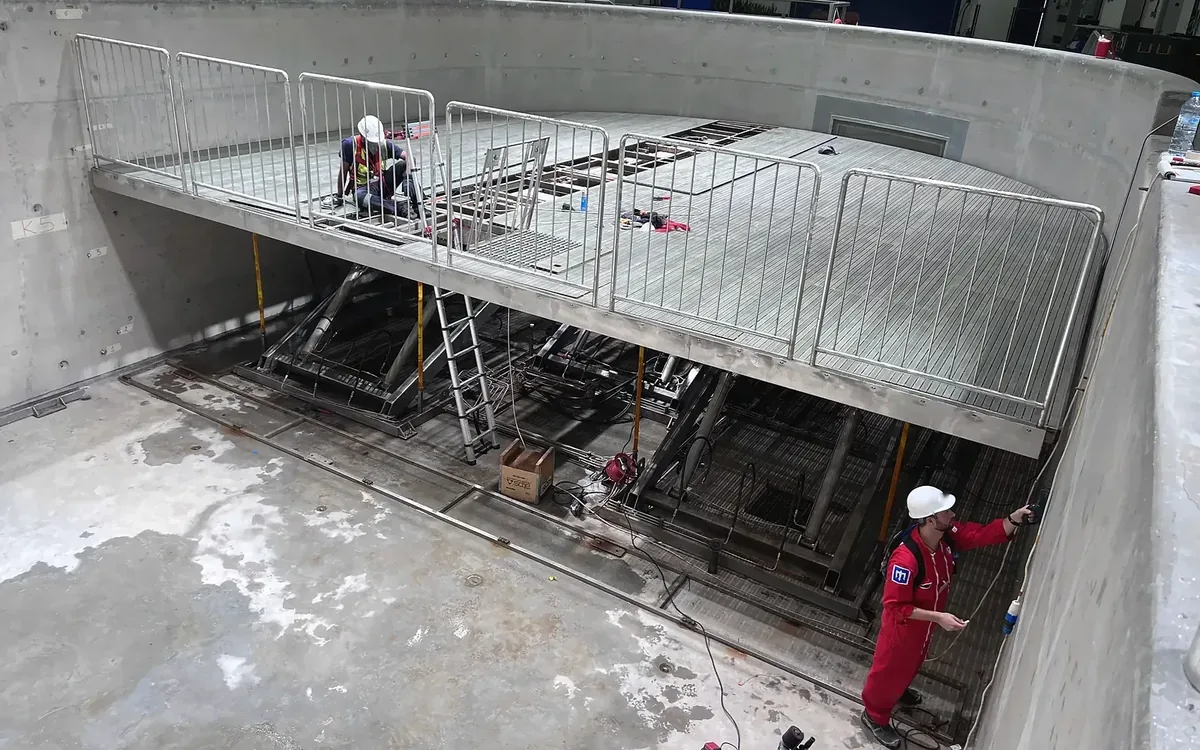
A leak is often not where the defect is
The watertightness of a tank, a pool or a raft is decided at the coating, at the substrate, and at every singular point: penetrations, upstands, joints and changes of direction. Thermal movement, already a MAREX subject on acrylic panels and seals, acts on these systems as well.
MAREX inspects and specifies waterproofing coatings, including polyurea and bituminous membranes of the type used on aquatic and marine structures. We look at adhesion, thickness, continuity, overlaps, moisture under the system and the condition of the concrete underneath. MAREX does not sell or apply coatings, and has no partnership, agreement or distributorship with any coating manufacturer.
We act as an independent expert: we only carry out repairs with the agreement of all parties, with no conflict of interest.
A coating is a system, not a single layer
A bonded waterproofing system typically has a prepared concrete substrate, a primer, a membrane, and a protection or wearing layer. The membrane may be a sprayed polyurea, a bituminous sheet or mastic, or another fully bonded system specified for the exposure.
Two typologies are common on tanks, pools and decks: hot-spray or cold-applied polyurea and polyurethane membranes, and cold-applied water-based bituminous rubber membranes. When a branded product such as Neptune Coatings WetSuit is present on a structure we inspect, it is cited only as an example of that typology, never as a partnership, a certification or a product endorsement. MAREX is an independent inspector: it does not sell or apply coatings, and is not a distributor or certified applicator of any brand.
Failure often starts at a singular point, or under a wearing course that hides the membrane. The absence of a visible leak is not proof that the system is sound: water can travel under the membrane and appear far from the defect.
Typologies we inspect, not products we sell
A waterproofing coating is specified as a system: substrate preparation, primer matched to residual moisture, membrane, and, where the membrane is aromatic and left exposed, an aliphatic UV topcoat. Thickness, climate window and curing times are those of the project TDS, not a generic number. The families below are typologies drawn from published manufacturer data. Naming a family is not a recommendation of a brand. MAREX has no agreement, partnership or distributorship with any coating manufacturer.
Hot-spray pure polyurea
Two-component, 100% solids, aromatic, tack-free in about 3 to 5 seconds. Typical specified minimum around 1.5 mm DFT (about 1.4 mm in some 25-year roof assessments; about 2.3 mm under asphalt on bridge decks). Elongation often above 350%, tensile above 20 MPa, pull-off on concrete commonly specified above 1.5 MPa (EN 1542). Spray equipment temperatures and pressures must match the TDS.
Cold-applied polyurea and liquid polyurethane
Hand-applied or airless membranes for roofs, details, repairs and recoats. Cold polyurea: pot-life around 20 to 25 minutes, elongation often above 500%. Moisture-cure polyurethane is applied in coats (often max. 0.7 mm per coat) or in a single coat with a catalyst; recommended total around 1.5 mm DFT. Recoat windows are short; missed windows need documented surface preparation.
Potable-water and UV-sensitive systems
Some solvent-free polyurethanes are specified for contact with water for human consumption, typically on unexposed tanks. They are generally not left in sunlight. Aromatic membranes that remain exposed require an aliphatic topcoat. We verify that the coating carries the potable-water certification required by the contract, and that the certificate matches the actual exposure, not the brochure headline.
Cold-spray bituminous rubber
Water-based, VOC-free, two-component instant-set or one-component self-levelling bituminous rubber membranes. Elongation can exceed 2,000%. Dry thickness depends on use: commonly about 60 mils for roofing, 80 mils vertical and 100 mils horizontal for waterproofing, 40 mils for air and vapour barriers (manufacturer FAQ). Instant-set grades can reach a high cure fraction in a few seconds; full cure is still checked with a moisture meter before loading.
Primers, details and topcoats
The primer is chosen for residual moisture: some polyurethane primers limit substrate moisture to about 4%; wet-tolerant epoxy primers may allow much higher residual moisture, up to the figure in their own TDS. Joints, penetrations and upstands are detailed with mastics, tapes and, where specified, reinforcement fleeces. These are hold points, not finishing trades.
What this is not
MAREX does not apply these products, does not sell them, and is not a certified applicator or distributor. We inspect reception of the substrate, application conditions, thickness and continuity, adhesion, and conformity with the specified TDS and project drawings.
Figures above are typological, taken from published English TDS and manufacturer FAQs reviewed in November 2026. The contractual values are those of the system actually specified on the project.
What we check, and against which rule
The list below is the inspection logic we use on new work, at handover, and in service. Criteria come from the project specification and the manufacturer TDS. Methods are standard test procedures and MAREX method sheets B6 and D5-1.
| Hold point | What we look for | Typical criterion (confirm in the TDS) | Method / standard |
|---|---|---|---|
| Concrete age and soundness | Cure, laitance, contamination, cracks, hollows, release agents | Often 28 days; substrate pull-off commonly >1.5 MPa before coating | Visual survey, rebound or pull-off on the substrate, EN 1542 / ASTM D7234 |
| Surface profile | Preparation by grinding, milling or shot-blasting as specified | ICRI Guide 03732, CSP 3 to 5 is widely required for these membranes | Visual comparators, ICRI CSP chips, site record |
| Residual moisture | Moisture in and on the substrate, including rising damp | Depends on the primer: about 4% for several PU primers; wet-tolerant primers up to the TDS figure (some up to 98%) | Moisture meter, gravimetric checks, TDS primer table; B6-5 only if justified |
| Climate window | Substrate and air temperature, dew point, ambient humidity | Often 3 to 35 °C for polyurea/PU; humidity often capped at 80 to 85%. Bituminous rubber: typically above 5 °C (minimum film-forming temperature), not on wet or freezing surfaces | Site logger, dew-point calculation, application record |
| Primer type and coverage | Correct primer for moisture and substrate, wet film, sand broadcast where specified | As the TDS (example: a thin PU primer coat around 50 to 60 g/m² plus 700 to 1,000 g/m² silica sand when a tile or wearing layer will be bonded) | Batch tickets, WFT gauge, photographic record |
| Equipment (hot spray) | Proportioner, temperatures, pressures, mix quality, drum mixing of side B | Example from a pure polyurea TDS: heater and hose temperatures around 70 to 75 °C, set-up confirmed on a test coupon | Machine log, test spray, TDS equipment table |
| Wet and dry thickness | WFT during application, DFT after cure, uniformity, number of coats | Often ≥1.5 mm DFT for liquid membranes; project or ETA/BBA may set 1.2, 1.4 or 2.3 mm. Bituminous rubber: mils as specified for the use (roof, waterproofing, air barrier) | WFT comb, dry-film gauge, cores or inspection windows (B6-3) |
| Recoat and overlaps | Time between coats and between work fronts | Pure polyurea often 10 seconds to 48 hours; missed windows need solvent clean and a thin bonding coat as the TDS | Time-stamped records, visual check of overlaps |
| Continuity | Pinholes, holidays, thin spots, especially at details | Zero holidays at the specified voltage for the DFT on tanks, pools and critical containment | Holiday / spark testing (ASTM D4787, ASTM D5162 or NACE SP0188), as the membrane and substrate allow |
| Adhesion | Failure stress and, just as important, the failure mode | Often >1.5 MPa on concrete (EN 1542); some systems publish higher laboratory values. Cohesive failure in the concrete is usually preferred to adhesive failure at the interface | Pull-off ASTM D4541 or ASTM D7234, EN 1542; MAREX sheet B6-4 |
| Singular points | Penetrations, upstands, joints, changes of direction, acrylic-to-concrete interfaces | Details as the drawings and the TDS (mastic, tape, fleece, upstand height) | Visual, water test where specified, inspection windows |
| UV protection | Aliphatic topcoat on exposed aromatic membranes | Required by many assessed roof systems when there is no physical covering | Visual, DFT of the topcoat, batch records |
| Service certificates | Potable water, roots, bridge deck, fire, traffic | The certificate must match the exposure and the potable-water reference required by the contract (NSF/ANSI 61 in the United States, WRAS / BS 6920 in the United Kingdom, or the applicable local reference). We do not treat a roof certificate as a drinking-water certificate. | Document review, certificate number and scope |
| Cure before loading | Walkability, water fill, backfill, asphalt, traffic | Example: polyurea walkable in about 3 hours, vehicular about 12 hours; bituminous rubber often 24 hours to limited traffic, with a moisture-meter check before load | TDS cure table, moisture meter, site programme |
| In-service diagnosis | Leaks that appear far from the defect, blisters, wet substrate | Progressive diagnosis: file, non-destructive survey, then local openings | Thermography (B6-1), windows (B6-3), moisture survey (B6-5), MAREX sheet D5-1 |
Photographs from MAREX inspections
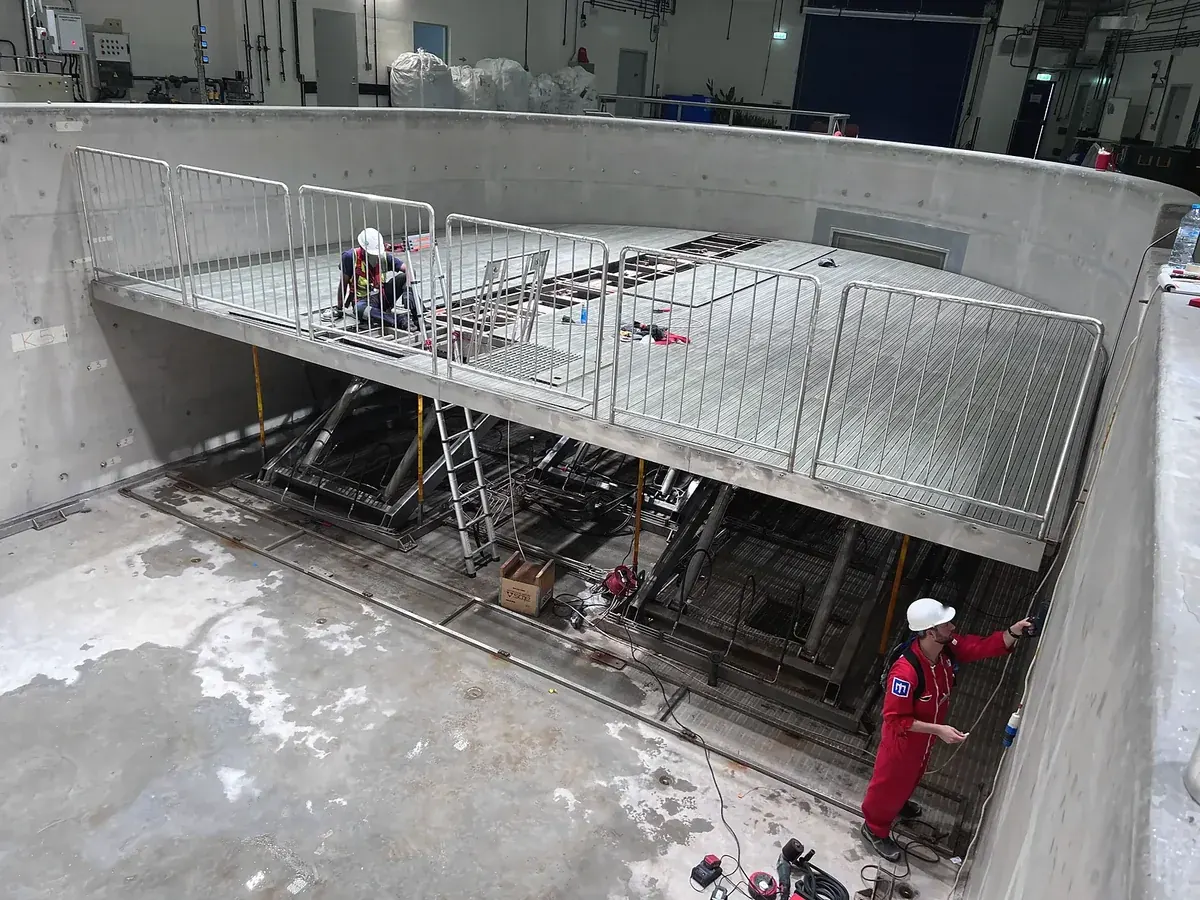
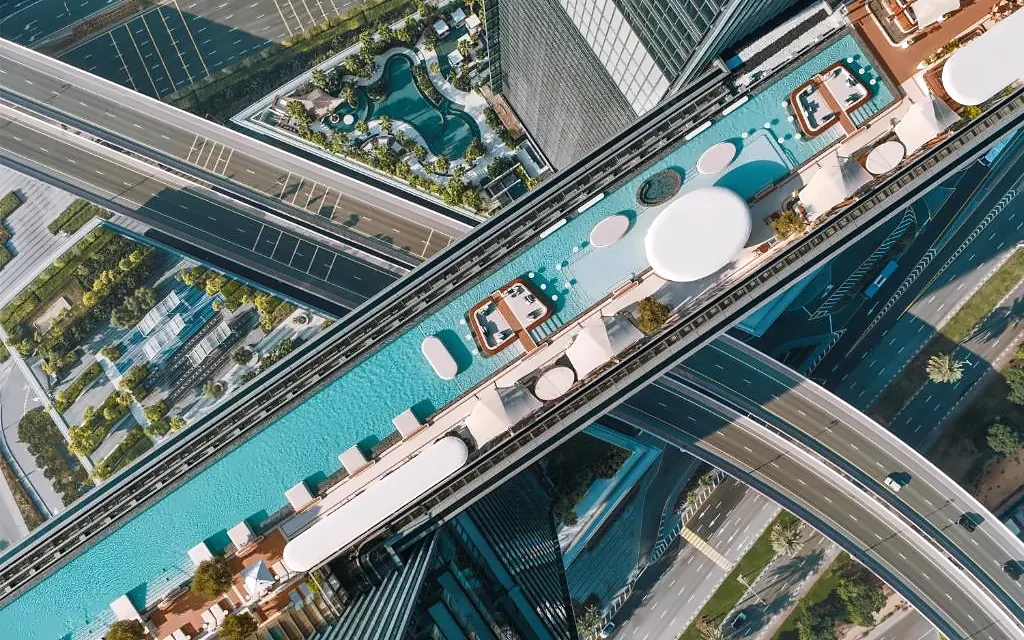
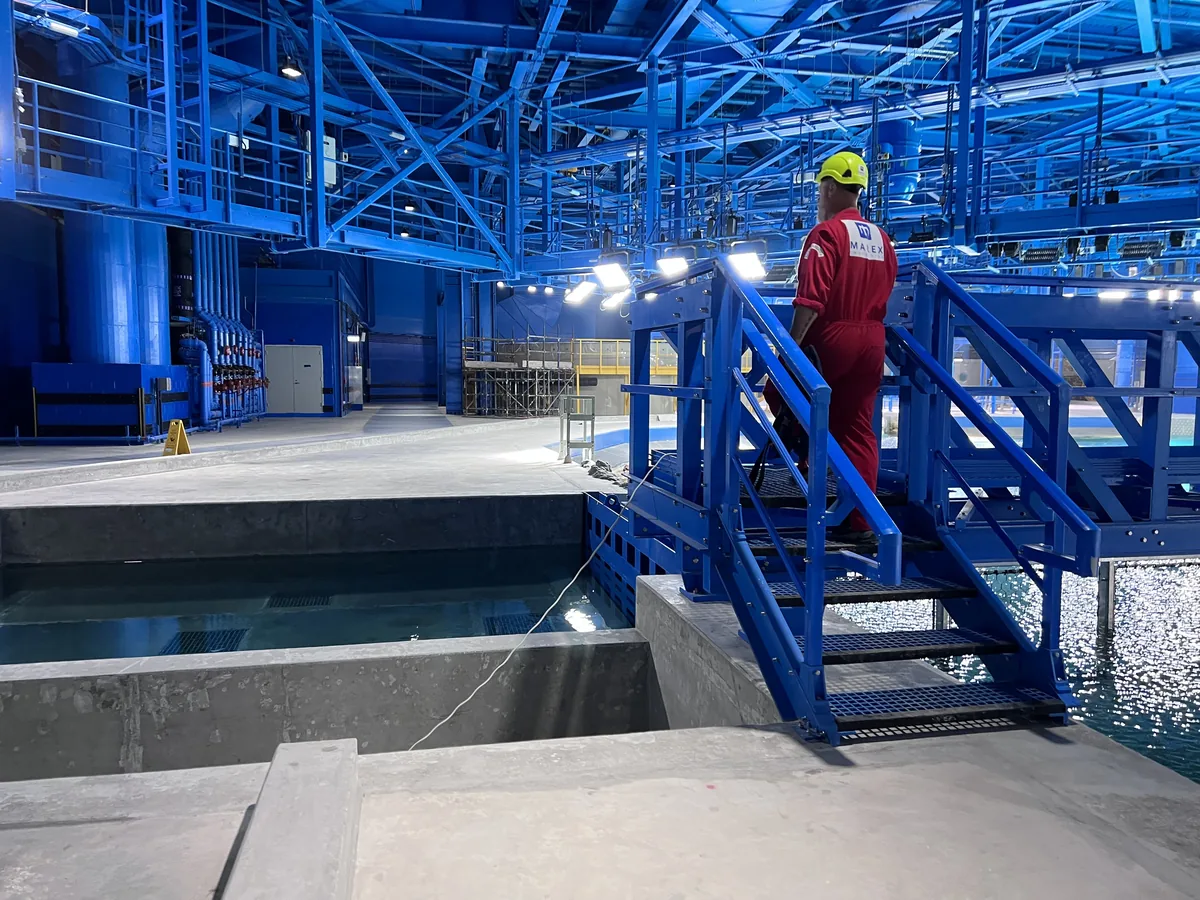
Photographs taken by MAREX during inspections of drained basins, architectural pools and public aquarium halls. Manufacturer application photographs are not used on this site.
What we look at
Adhesion and pull-off
Direct tensile pull-off tests on a fully bonded system, to record the failure stress and the failure mode (B6-4), to ASTM D4541 or ASTM D7234 and EN 1542, against the TDS value (often above 1.5 MPa on concrete).
Thermography
Infrared survey to locate lack of adhesion, blisters and air pockets under sheet waterproofing (B6-1).
Thickness, continuity and moisture
WFT and DFT against the specified minimum, holiday or spark testing on tanks and pools, inspection windows for layers and condition (B6-3), and moisture surveys where they are justified (B6-5).
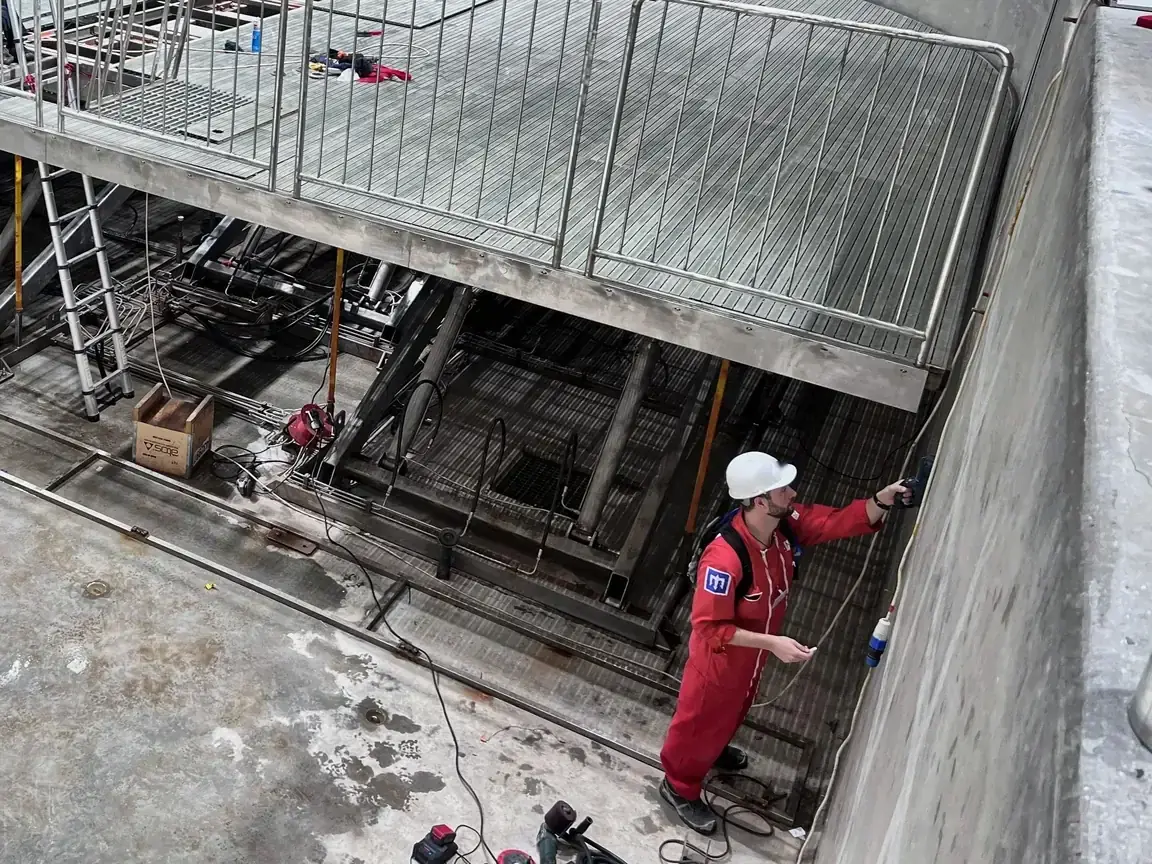
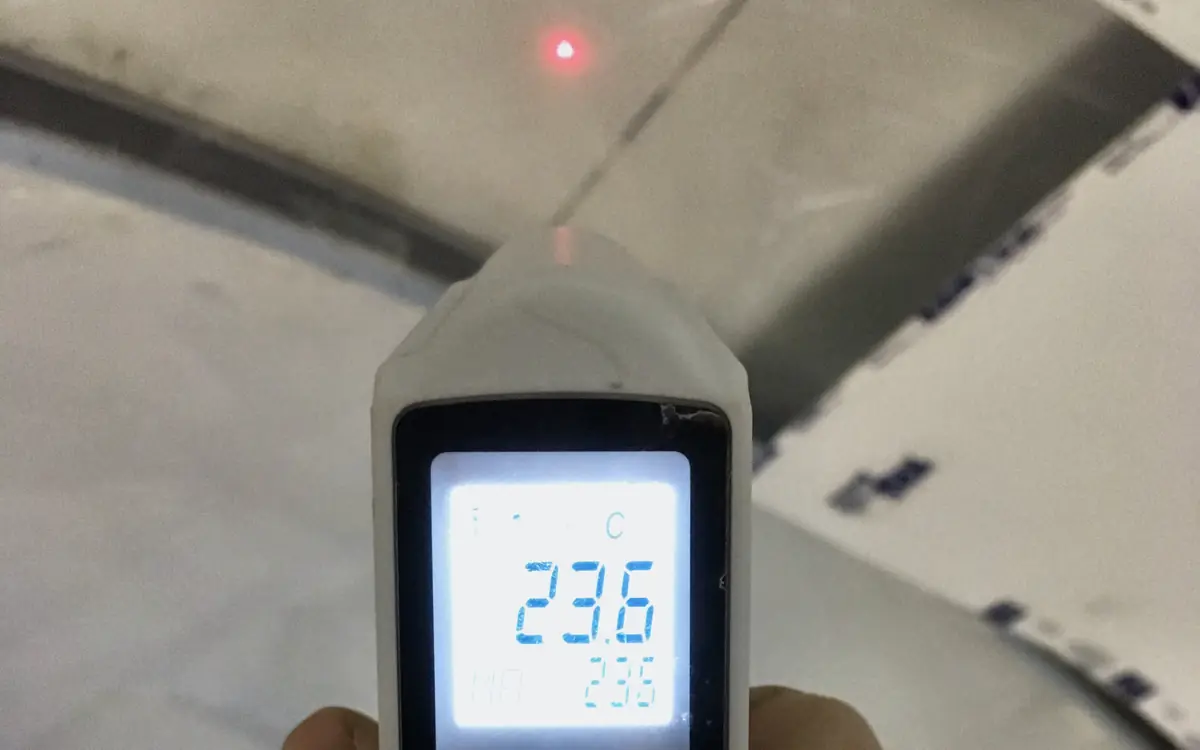
Measurements on a drained basin, and infrared temperature readings in the field. A waterproofing diagnosis is progressive: simple, non-destructive actions first, then more local openings if the findings require them (D5-1).
Where these systems are used
- Aquarium tanks and life-support basins, including the concrete that frames acrylic panels.
- Architectural and hotel pools, including cantilevered and rooftop basins, where waterproofing, acrylic and structure meet.
- Marine and coastal concrete, and basement rafts, where a coating or membrane is part of the watertightness strategy.
- Buried or covered decks and planter structures, where the membrane is hidden and can only be judged by survey, windows and tests.
- Potable water reservoirs. MAREX inspects the waterproofing of drinking-water tanks and verifies that the coating as installed carries the potable-water certification required by the contract: NSF/ANSI 61 in the United States, WRAS / BS 6920 in the United Kingdom, or the applicable local reference. The usual checks apply: substrate and moisture, wet and dry film thickness, holiday or spark testing, pull-off adhesion, and cure before the tank is returned to service. Reference: Potable water reservoir, 5,000 m³, Belgium: polyurea application quality control (2021-2022).
The same questions recur: was the substrate prepared for the system, were the application conditions respected, and how are penetrations, joints and upstands detailed? Sheet D5-1 sets out a three-stage diagnosis, from the file to the site and, where needed, to investigation windows.
What you receive
The deliverable is a signed inspection report, with each finding located and photographed.
- A record of the system as found: layers, continuity, overlaps, penetrations, upstands and the condition of the substrate, as far as the inspection can establish them.
- Findings ranked by priority, with recommended actions while the contractor is still on site whenever that is possible.
- A diagnosis that starts with simple, non-destructive actions, then local openings if the findings require them, following the logic of method sheet D5-1.
- A response to every request for proposal within 24 hours, followed by a structured technical and commercial proposal.
What this changes for the operator
Defects found before a leak appears far away
Water can travel under a membrane and appear far from the defect. The absence of a visible leak is not proof that the system is sound.
Inspection at the right moment
Inspections are planned on new work, at handover, or in service, so that actions can be taken while the contractor is still on site whenever that is possible.
A signed, located record
Findings are located, photographed and ranked in a signed report that the operator, the contractor and the insurer can use.
A response within 24 hours
Every request for proposal receives a response within 24 hours, then a structured technical and commercial proposal.
Leaking basement raft, reclaimed land, Dubai
An anonymised MAREX mission already published on the Projects page. The waterproofing details of the raft were part of the diagnosis.
Context
Hotel and residential development on reclaimed land. The basement raft slab sits permanently in salt-laden groundwater.
Method
Review of the concrete mix design, the waterproofing details and the contractor answers. Interpretation of laboratory tests on the seepage water: pH, chlorides, sulphates, conductivity and iron.
Finding
Construction joints relied on injection hoses only, with no passive waterstops. Seepage water contained about 6,000 mg/L chlorides, up to 1,730 mg/L sulphates, and dissolved iron. Resin injection treated the leak, not the corrosion already under way behind it.
Next step
A staged plan: half-cell mapping to ASTM C876, cores for chloride profiles, re-sealing of active leaks with hydrophilic grout, cathodic protection and permanent corrosion monitoring.
Protocol sheets that inform this work
The sheets below are MAREX English method sheets for bonded waterproofing. The methods (thermography, pull-off, inspection windows, moisture survey) apply to tanks, pools, decks and other bonded systems. They are listed as method references, without a public download on this site at this stage.
- B6-1Bonding defects by infrared thermographyLack of adhesion, blisters and air pockets under sheet waterproofing.
- B6-3Inspection windows in the screed and surfacingLayers, thickness and condition, and calibration of non-destructive surveys.
- B6-4Direct tensile pull-off testFailure mode and failure stress of a fully bonded waterproofing system.
- B6-5Neutron moisture surveyLocating moisture in and under the wearing course and waterproofing. A specialised, regulated method; listed as a reference, not as a routine MAREX field instrument.
- D5-1Diagnosis of waterproofingConsequences of failure, programming, and the three-stage methodology.
Related reading and the next step
A coating is a system, not a single layer
Why singular points, overlaps and the substrate decide whether a membrane holds.
Read the note → SpecialityReinforced concrete inspection
When a leak is also a sign of rebar corrosion, the two diagnoses belong together.
View the service → Next stepRequest a proposal
Send the scope, drawings and timeline. We respond within 24 hours.
Request a proposal →Planning an inspection programme or a tender?
Send us your scope, drawings and timeline. We return a structured technical and commercial proposal.